Abou Rjeily Family background

Back to the main page

Atallah is the earliest known ancestor of the Abou Rjeily family, whose documented history begins in the seventeenth century in Mount Lebanon.

He was the son of Nasr, who was himself the son of Merjan. Nasr had a brother, Nader, from whom the Nader and Berberi families descend.

Merjan belonged to a Christian family that had migrated from Hawran (in present-day Syria) to Kesrouan, and later to Jbeil, following the Islamic conquest of the region in the seventh century. His family eventually settled in Barbara, where they remained for generations in order to preserve their faith.

In the early seventeenth century, Atallah left Barbara and moved to the village of Ktéléh in Metn, situated in the valley between the Metn and Aley districts. At that time, the area was one of the feudal domains of the Lamaï princes, notably Prince Murad el-Lamaï.

Atallah married and fathered four sons: Elias, Farès, Yaghi, and Dib.

As they grew older, his sons distinguished themselves through their dedication to Prince Murad. During a visit to congratulate the prince on a significant achievement, Murad publicly addressed Atallah as “Abou al-Rijal”Father of the men—in recognition of the services he and his sons had rendered. This honorific soon became the family’s collective name. Over time, “Abou al-Rijal” evolved linguistically into “Abou Rjeily.”

As they grew older, his sons distinguished themselves through their dedication to Prince Murad. During a visit to congratulate the prince on a significant achievement, Murad publicly addressed Atallah as “Abou al-Rijal”Father of the men—in recognition of the services he and his sons had rendered. This honorific soon became the family’s collective name. Over time, “Abou al-Rijal” evolved linguistically into “Abou Rjeily.”

The descendants of Atallah multiplied until tensions arose between them and the Lamaï princes, sons of Murad. In accordance with the customs of the era, the family chose to leave the region.
One group relocated to Bhamdoun, Hab Ramoun, Ramlié, and nearby villages under the authority of the Abed el-Malak family.
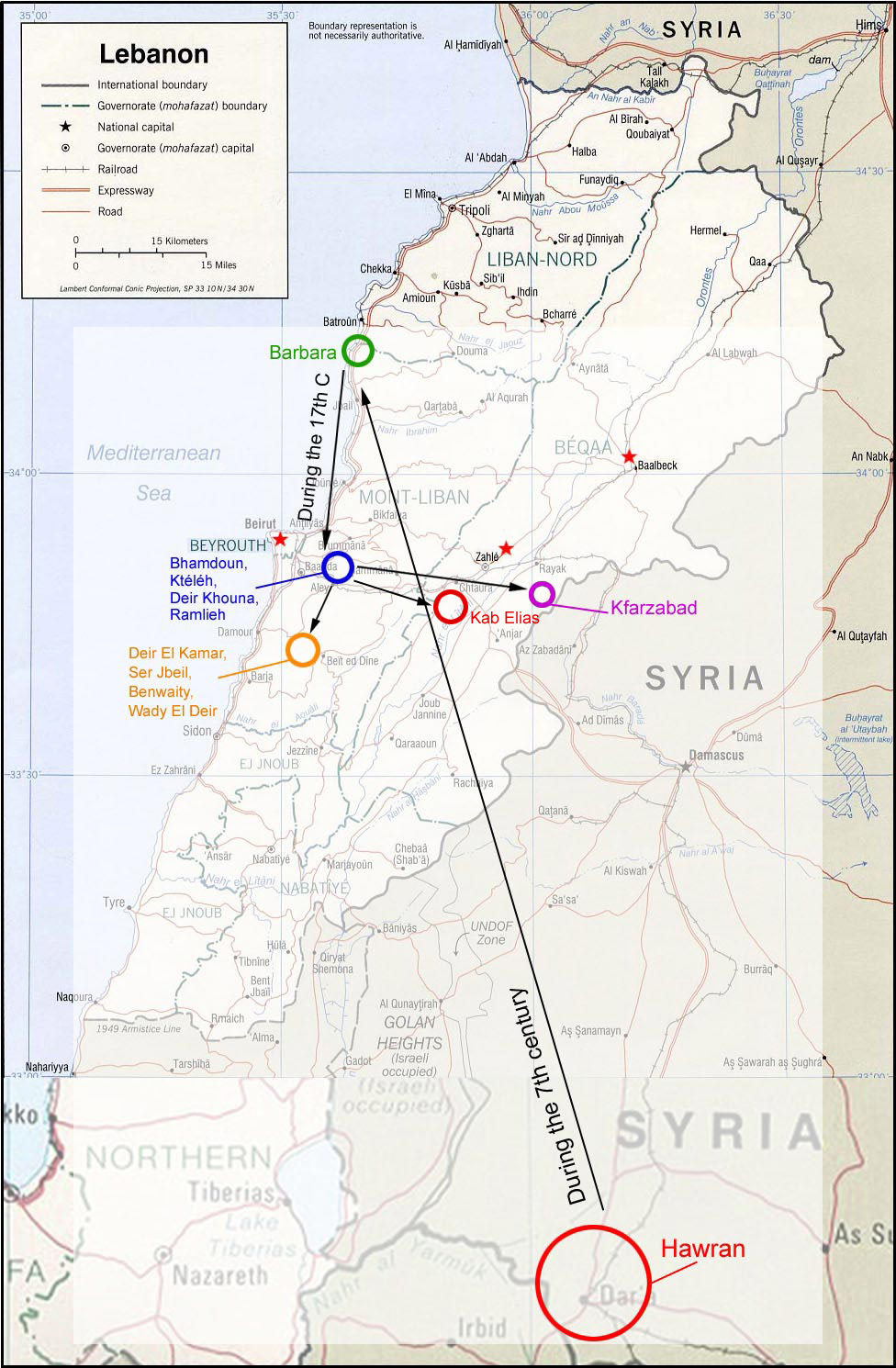
Another group moved toward the Bekaa Valley. When this group reached Chbaniéh, part of the fief of Kaed Bey el-Lamaï, a cousin of Prince Murad, the prince prevented them from advancing further into the Bekaa and directed them to settle in Deir Khouna, near Ktéléh and within his own domain. Kaed Bey attempted to reconcile them with his cousins, the Lamaï descendants of Murad. Some families returned to Ktéléh, while others remained in Deir Khouna.

Today, the Abou Rjeily families of Beirut, Chiyah, Taltita, Chbanié, Hammana, Kab Elias, Zahlé, Baalbeck, and Kfarzabad descend from these two branches.
The families residing in Mazraat el-Nahr, Rishmaya, Kfarmatta, Ser Jbeil, Benwayté, Deir El-Kamar, Wadi el-Deir, Amik, Tehzaniyé, and Ain el-Sindiyani—all villages in the Chouf region south of Aley—descend from the group that settled in Bhamdoun, Hab Ramoun, and Ramlié.

By the late nineteenth century, and especially before World War I, many members of the Abou Rjeily family emigrated from Mount Lebanon during a major wave of Christian migration that nearly emptied parts of the region. They settled across the world:
– in the United States, adopting names such as Bourjaily, Abojaily, Aborlleile;
– in Argentina, as Aburgeily and Aburllaily;
– in Brazil, as Abourejaili and Bou-Rjaili;
– and in Canada, Australia, France, Sweden, and other destinations.